2026 guide · Estate agency in Málaga
Buying in Málaga: prices, neighbourhoods and the tourist licence
Málaga is no longer the city you pass through on the way to the Costa del Sol: it has become the city where people settle. In three years the price per square metre has risen without a break, the old town has changed, and the city council has closed the door to new holiday rentals. Buying here in 2026 therefore means understanding two things before anything else: what each neighbourhood really costs and what you will be allowed to do with the property once you own it.
This page brings together the latest public figures, the rule that currently blocks holiday rentals across the whole municipality, and what it changes in practice for a buyer from the UK, Ireland, Scandinavia, the Netherlands or elsewhere. Everything is dated and sourced at the bottom of the page. If it cannot be checked, you will not find it here.
Málaga city, August 2026, +5.1% over one year
long term, August 2026, +2.8% over one year
Q2 2026, national average: 6.5%
The point that changes everything: the tourist licence is frozen
This is the first question to ask, before you even look at listings. Since 23 August 2025, Málaga city council has suspended the registration of any new vivienda de uso turístico (VUT, the Andalusian holiday rental licence) across the whole municipality. The measure is based on article 6 of Andalusian Decree-Law 1/2025 and was published in the provincial Official Gazette (BOP) on 22 August 2025.
In practice: a flat bought today in Málaga city can, as a general rule, no longer be registered as a holiday rental. Having residential use is no longer enough to open that right.
The suspension runs for a maximum of three years, or until the amendment to the town plan (PGOU) is approved , whichever comes first. A further, even stricter PGOU amendment received initial approval published in the BOP on 24 July 2026 and came into force the next day.
Even before this general freeze, 43 neighbourhoods were already closed to new licences: those where holiday rentals exceed 8% of the housing stock. They include the Centro Histórico, Ensanche Centro, La Victoria, La Malagueta and El Palo, which are precisely the areas most investors look for.
This approach was written into the town plan itself on 25 July 2026, together with a second measure on converting commercial premises into homes. We explain it in our analysis of the Málaga PGOU amendment.
What this means for you, both ways
If you want to start a holiday rental in Málaga city: this is not the time, and it is not the right city. We would rather tell you straight away than let you buy and then hit the wall. The neighbouring towns, Torremolinos, Benalmádena, Fuengirola, Mijas , each have their own rules, and not all of them are closed. It is a conversation to have town by town.
If a property is already registered as a VUT, it becomes a rare asset. Existing licences keep working as long as the property stays compliant (habitability, safety, tax obligations). In a city that no longer issues them, a licensed flat is worth more, and this already shows in sale prices. If you view one, have the registration code checked before making any offer: much of the value lies there.
One last technical point that is often forgotten: even before the freeze, licences were no longer granted to homes without independent access from the street and without their own services. This requirement will remain the basis of any future application.
Málaga’s neighbourhoods and what they cost
Málaga is not a single market. From one district to another, prices can double. These are the asking prices by district, recorded in August 2026.
| District | € / m² | Over one year |
|---|---|---|
| Este El Limonar, Pedregalejo, El Palo | €4,990 | +6.5% |
| Centro Centro Histórico, Soho, La Malagueta | €4,574 | +5.8% |
| Carretera de Cádiz Huelin, La Princesa, Paseo Marítimo Oeste | €4,191 | +7.9% |
| Teatinos university, recent buildings | €3,966 | +6.4% |
| Cruz de Humilladero | €3,374 | +8.1% |
| Bailén – Miraflores | €3,286 | +7.9% |
| Martiricos – La Roca | €2,900 | −11.1% |
| Churriana near the airport | €2,852 | −0.3% |
| Puerto de la Torre | €2,796 | +5.3% |
| Ciudad Jardín | €2,715 | +16.5% |
At neighbourhood level the gaps are wider still. Figures from April 2026: Malagueta – Monte Sancha at €7,129/m² and Paseo Marítimo Oeste – Pacífico at €7,103/m² are the top of the market; Centro Histórico at €5,961 and Ensanche Centro – Soho at €5,508 follow; Pedregalejo – Morlaco at €5,084 (+25.9% in one year) is the fastest-rising neighbourhood. At the other end, Ciudad Jardín (€2,518), Churriana (€2,564) and Cortijo de Maza (€2,624) remain the most affordable areas of the city.
The key fact of 2026: Málaga no longer has a truly cheap neighbourhood close to the centre. Huelin, Pedregalejo and La Trinidad, long seen as the bargains, have all passed €4,000/m².
How we read these neighbourhoods
- Centro Histórico and Soho : the best resale, the strongest rental demand, and the tightest licence restrictions. You buy here for the value of the property, not for yield.
- Este (El Limonar, Pedregalejo, El Palo) : the most pleasant place to live, popular with families and year-round residents. High prices, but a market that does not fall back.
- Carretera de Cádiz (Huelin, La Princesa) : the beach without city-centre prices, real neighbourhood life and +7.9% in a year. Our favourite area for a first long-term buy-to-let.
- Teatinos : recent buildings, lifts, garages, the university next door. Steady rental demand all year from students and hospital staff. The best balance between easy management and yield.
- Churriana, Puerto de la Torre, Ciudad Jardín : the entry tickets. Best for buyers who know the city: the exact location matters a great deal.
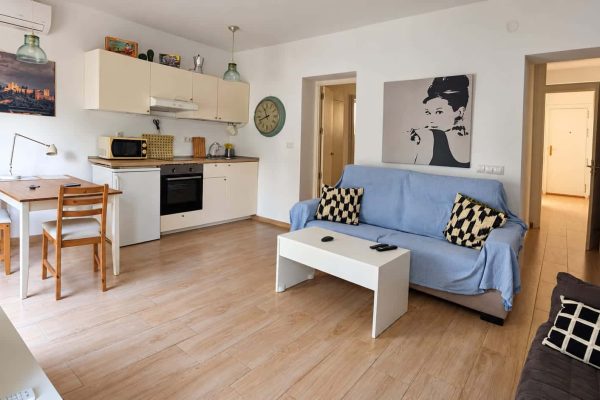
We currently have one property in Málaga itself: a renovated, furnished 3-bedroom apartment at Sky Garden, Teatinos.
What buying really costs
The asking price is never the price you pay. In Andalusia, allow about 9 to 10% in extra costs on a resale property (7% ITP transfer tax, notary, land registry, lawyer) and about 13% on a new build (10% VAT + 1.2% AJD stamp duty). On a €300,000 flat, that is between €27,000 and €39,000 on top of the price.
The line-by-line breakdown, with both resale and new-build tables, is in our guide to property investment in Spain.
The seven steps of a purchase, in order
Buying in Spain when you live elsewhere is not complicated, but the order matters. This is the real sequence our clients follow.
- The NIE : the foreigner identification number. Without it there is no signing at the notary, no bank account and no tax payment. You apply at the Spanish consulate in your country or in Spain by appointment. Start this first, because it takes the longest.
- A Spanish bank account : essential to pay for the property, community fees, water, electricity and local taxes. It is opened with your NIE and proof of income.
- The offer and the arras contract : once the offer is accepted, you sign a contrato de arras with a deposit, usually 10% of the price. Be careful: depending on the type, the buyer loses the deposit if they withdraw, and the seller must repay it twice over if they pull out. Add a conditional clause if your purchase depends on a mortgage.
- The checks : the step you never skip: a recent nota simple from the land registry (actual owner, mortgages, charges), community debts, IBI property tax paid up, cadastral compliance of any works and, if you plan to rent, the exact status of the tourist licence.
- Signing the escritura : the public deed before a notary. You can sign remotely by power of attorney, as most of our non-resident clients do.
- Registration and taxes : registration at the land registry and payment of ITP (or VAT and AJD on a new build) within the legal deadlines.
- Getting set up : transfer of water and electricity contracts, rubbish tax, insurance and joining the owners’ community. Then, every year, the non-resident tax return (modelo 210).
We support you through all seven steps and put you in touch with an independent lawyer: the legal sign-off is theirs, not ours.
The mistakes we see most
These are not rare cases. They come back year after year with serious, well-meaning buyers.
Assuming a tourist licence
This has been the number one trap in Málaga since the licence freeze. A seller, or even an agency, may say in good faith that a flat “rents really well as a holiday let”. Until you have seen the VUT registration code and checked that it is active and attached to that exact property, assume it has no licence, and that today, in Málaga, you will not be able to get one.
Inheriting community debts
In Spain, unpaid community fees follow the property, not the seller. Article 9.1.e of the Horizontal Property Act makes the buyer liable for amounts owed for the current year and the three previous calendar years. Ask for a certificate from the community confirming there are no debts before signing.
Signing arras without a safety net
The arras contract is binding. If your purchase depends on a mortgage and the bank says no, without a conditional clause you lose your deposit, often 10% of the price.
Underestimating costs
Many buyers set their budget on the asking price. You need to add 9 to 10% on a resale and about 13% on a new build. On €300,000, that is €27,000 to €39,000 you must have available on top, at the right time.
Works that were never declared
An enclosed terrace, an added room, a studio built in the basement: if it is not in the cadastre or the land registry, it does not legally belong to you, it can block a resale and it can be held against you. The real floor area and the registered one must match.
Forgetting the 3% withholding on resale
When a non-resident seller sells a property in Spain, the buyer must withhold 3% of the price and pay it to the Spanish tax office. If you sell one day as a non-resident, it affects your cash flow; if you buy from a non-resident, withholding it is your responsibility.
Renting out in Málaga: what it really brings in
Here is the figure few agencies show: the gross yield on a long-term buy-to-let in Málaga city was 5.2% in the second quarter of 2026. It is falling year after year (5.9% in 2023, 5.8% in 2024, 5.4% in 2025) and is now below the Spanish average of 6.5%.
The reason is simple and worth accepting: purchase prices are rising faster than rents. +5.1% for purchases over one year, only +2.8% for rents. Buying in Málaga today means buying a solid asset in a city that attracts people; it no longer means buying a high yield.
| District | € / m² / month |
|---|---|
| Este | €17.8 |
| Centro | €17.6 |
| Carretera de Cádiz | €16.9 |
| Puerto de la Torre | €15.5 |
| Churriana | €15.4 |
| Bailén – Miraflores | €15.1 |
| Cruz de Humilladero | €14.8 |
| Teatinos | €14.7 |
| Ciudad Jardín | €13.1 |
| Campanillas | €12.4 |
A concrete example: a 70 m² flat in Teatinos bought at around €3,966/m², so €277,600, rents for around €14.7/m²/month, so €1,029 a month, or €12,348 a year: about 4.4% gross before community fees, IBI, insurance and empty periods. “Gross” means before all of that.
On our holiday rentals on the Costa del Sol, we see gross yields of around 6 to 10%, against 4 to 7% for long-term lets. These are figures from our own portfolio, not a promise: seasonality, exact location and quality of management make all the difference. In Málaga city, the licence freeze now closes that door to any unlicensed property.
Tax in two lines
If you are tax resident in the European Union, your Spanish rental income is taxed at 19% on net income, with expenses deductible. Outside the EU (United Kingdom, Switzerland, Norway, United States) it is 24% on gross income, with no deductions at all. The difference is significant and must go into the calculation before you buy, not after.
On top of this come the deemed income on a property you do not rent out, the annual modelo 210 return and the 3% withholding on resale. The details, with deadlines and forms, are on our property investment page. We are neither lawyers nor tax advisers: we point you in the right direction and put you in touch with the right people.
How we work in Málaga
VivaStay is an estate agency based in Málaga (registered estate agent API 525). Most of the owners and buyers we work with do not live in Spain; that is exactly our job.
- Search and viewings : we view properties for you, on video, and we also tell you what is wrong.
- Checks before an offer : tourist licence status, community fees, cadastral situation and any debts.
- Administrative support : NIE, bank account, notary, introductions to a lawyer and a gestor.
- Full rental management : after the purchase we look after the property, the guests or tenants, the cleaning and anything unexpected. This is our concierge service.
- Works and home staging : we oversee renovation works and prepare the property before it goes on the rental market.
Our properties in Málaga
I am marketing properties in the municipality of Málaga, in Puerto de la Torre, Los Guindos and Teatinos, for sale and for long-term rent.
- Detached villa in Puerto de la Torre : €1,200,000, for sale.
- Detached house in Puerto Sol, Puerto de la Torre : €990,000, for sale.
- Apartment in Los Guindos : €450,000, for sale.
- Renovated, furnished apartment at Sky Garden, Teatinos : 3 bedrooms, 127 m², €1,850 a month on a long-term let.
Let’s talk about your project in Málaga
Tell us your country of tax residence and what you are looking for. We will reply personally, in English, French or Spanish, with an honest answer, including when the answer is “not in Málaga, try next door”.
Frequently asked questions
Can I still run a holiday rental in Málaga in 2026?
Not with a newly registered property. Since 23 August 2025, registration of new VUTs has been suspended across the whole municipality of Málaga, for a maximum of three years or until the PGOU amendment is approved. Properties already registered keep working. Neighbouring towns on the Costa del Sol apply their own rules and need to be looked at one by one.
What is the average price per m² in Málaga?
€3,938/m² to buy in August 2026 for the city, up 5.1% in one year. Depending on the district, the range runs from €2,715 (Ciudad Jardín) to €4,990 (Este), and above €7,000/m² in the seafront neighbourhoods.
What yield can I expect?
5.2% gross on a long-term let in Málaga city in Q2 2026, falling steadily since 2023 and below the national average of 6.5%. “Gross” means before costs, taxes and empty periods. Across our Costa del Sol portfolio, holiday rentals sit more between 6 and 10% gross, and long-term lets between 4 and 7%.
Do I need an NIE to buy?
Yes. The foreigner identification number is required to sign at the notary, open a bank account and pay the taxes linked to the property. We help you with the application.
How much should I budget on top of the purchase price?
About 9 to 10% on a resale and about 13% on a new build, fees and taxes included. On a €300,000 property, that is €27,000 to €39,000 extra.
Is it still worth investing in property in Spain?
It depends on what you are looking for. If you want a high yield, Spain is no longer the market it was: in Málaga, the gross long-term yield fell from 5.9% in 2023 to 5.2% in Q2 2026, below the national average of 6.5%. If you want an asset that grows in value in a city that attracts residents all year round, with the option of using it yourself, the answer is still yes: purchase prices in Málaga rose 5.1% in the last year alone.
Which mistakes should I avoid when buying property in Spain?
The six we see most: assuming a property can be let to tourists without checking its VUT code; inheriting community debts, which follow the property for the current year and the three previous ones; signing an arras contract without a mortgage condition; underestimating the 9 to 13% in costs; buying a property with works not declared in the cadastre; and forgetting the 3% withholding on resale by a non-resident.
Which neighbourhoods should I invest in in Málaga?
For a long-term let that is easy to manage, Teatinos (€3,966/m² to buy, €14.7/m²/month to rent) and Carretera de Cádiz around Huelin and La Princesa (€4,191/m², €16.9/m²/month) offer the best balance. For an asset to grow in value and enjoy, the Este district (El Limonar, Pedregalejo, El Palo) and the Centro Histórico remain safe choices, at clearly higher prices. Entry-level prices are in Ciudad Jardín, Churriana and Puerto de la Torre.
Can I buy in Spain without living there?
Yes, and most of our clients do. You need an NIE and a Spanish bank account, and the notary signing can be done remotely by power of attorney. You will then have to file the annual non-resident return, modelo 210.
Should I buy in Málaga city or in a neighbouring town?
It depends entirely on your goal. For an asset that grows in value and for personal use, Málaga city remains a very good choice. For a holiday rental project, the licence freeze makes the city unsuitable today, and you should look at Torremolinos, Benalmádena, Fuengirola or Mijas, each with its own rules.
Beyond Málaga, there are differences between Spanish law and the law of your home country that cost dearly when found out too late. We have gathered them here: the mistakes to avoid when buying in Spain.
Talk to someone on the ground about your project
This page gives you the figures. It will not tell you whether your project works in Málaga: that depends on your budget, your tax situation and what you want to do with the property. That is what a first call is for. VivaStay is an estate agency on the Costa del Sol : I sell properties and manage rentals, which lets me tell you what a flat really earns.
Sources and dates
- Idealista, sale price report, Málaga city, August 2026 : €3,938/m², +5.1% over one year, and table by district.
- Idealista, rental price report, Málaga city, August 2026 : €16.5/m²/month, +2.8% over one year, and table by district.
- Idealista, gross rental yield, Málaga city, Q2 2026 : 5.2%; history 5.9% (2023), 5.8% (2024), 5.4% (2025); national average 6.5%.
- Neighbourhood figures recorded in April 2026 (Idealista data, reported by the local press).
- Ayuntamiento de Málaga, planning department statement: suspension of new viviendas de uso turístico across the whole municipality, Junta de Gobierno Local agreement published in the BOP of 22 August 2025, in force from 23 August 2025, for a maximum of three years or until the PGOU amendment is approved.
- Andalusian Decree-Law 1/2025 of 24 February 2025, article 6: the legal basis for the municipal suspension.
- Málaga PGOU amendment, initial approval published in the BOP of 24 July 2026, in force from 25 July 2026.
- The 43 saturated neighbourhoods: new licences already blocked where holiday rentals exceed 8% of the housing stock.
- Non-resident tax: IRNR 19% (EU/EEA residents, on net income) and 24% (outside the EU, on gross income); Andalusian ITP 7% ; new builds: VAT 10% + AJD 1.2%.
Page updated on 9 September 2026. Market figures change and holiday rental rules move fast: we check them regularly, but always verify the exact situation of a property before committing. This information is for guidance only and is not personalised legal or tax advice.